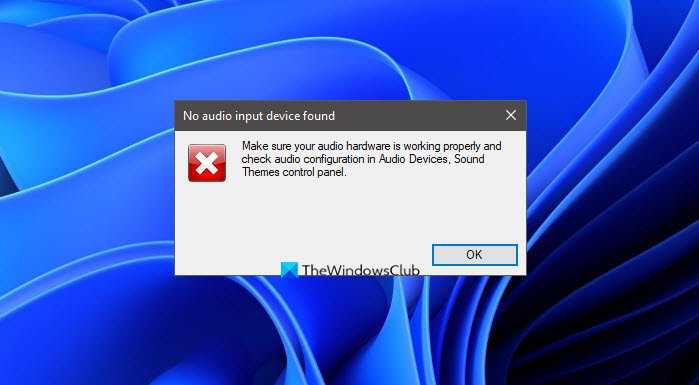
Some users reported that the sound of the computer stopped working completely when they install and update Windows 11/10. This issue comes with an error message – No audio input device found. If you are facing such an audio issue on your computer then this tutorial may help you resolve the issue.
No audio input device found on Windows 11
Let’s now see them in detail:
1] Restart your computer
An audio device error can occur when any hardware configuration is modified while Windows is being loaded. In order to avoid this problem, it is imperative that you do not remove or attach any peripheral devices while your computer is starting.
Once your computer has fully loaded, you can perform these tasks. If the error persists, it may be fixed by restarting your computer.
2] Run the Audio Troubleshooter
Hopefully, that will solve the issue. If that doesn’t work, try the next solution.
3] Update the Sound driver
4] Get the new driver and install it
Once the driver has been installed successfully, see if the problem has been resolved.
Why is there no sound on my PC?
You may experience sound problems on your computer due to a number of factors, such as speakers, software, audio drivers, or sound card. Most Windows sound-related problems are caused by a misconfiguration that can be resolved with a few simple steps. To fix the problem, you can run the audio troubleshooter, update the Sound driver, and get a new audio driver.
Troubleshoot recording and playback errors in Audition
Troubleshooting recording and playback issues in Adobe Audition
Audition provides helpful messages and recommendations to troubleshoot and resolve known hardware communication issues. Please find your error message below for additional steps and information.
Steps: Click the Audio Hardware button, or open Preferences > Audio Hardware and select a Default Output device.
Steps: Click the Audio Hardware button, or open Preferences > Audio Hardware and select a Default Input device.
Steps: Click the Audio Hardware button, or open Preferences > Audio Hardware and select a Default Output device. You may wish to click System Audio Settings to review the operating system device settings.
Steps: Click the Audio Hardware button, or open Preferences > Audio Hardware and select a Default Input device. You may wish to click System Audio Settings to review the operating system device settings.
Steps: Click the Audio Hardware button, or open Preferences > Audio Hardware and review the Default Output device. You may need to select a different default output device, click Apply, then select your primary device once more. You may wish to click System Audio Settings to review the operating system device settings.
Steps: Click the Audio Hardware button, or open Preferences > Audio Hardware and review the Default Input device. You may need to select a different default input device, click Apply, then select your primary device once more. You may wish to click System Audio Settings to review the operating system device settings.
Steps: Click the Audio Hardware button, or open Preferences > Audio Hardware and review the Default Input device. You may wish to click System Audio Settings to review the operating system device settings.
Проблема с доступом к звуковой карте несколькими приложениями (РЕШЕНО)
Собственно, проблема решилась установкой Pulse Audio. Очень странно, что это PA не поставилось по умолчанию (похоже, только в Kubuntu так, хотя Gnome/Xfce-based дистры не пробовал..)
Кот что пишет mplayer:
$ mplayer yellow.wav MPlayer SVN-r28403-4.3.2 (C) 2000-2009 MPlayer Team CPU: AMD Athlon(tm) 64 Processor 3000+ (Family: 15, Model: 47, Stepping: 0) mplayer: could not connect to socket mplayer: No such file or directory Failed to open LIRC support. You will not be able to use your remote control.
MPlayer interrupted by signal 2 in module: play_audio A: 2.7 (02.6) of 156.0 (02:36.0) 1.3% Exiting. (Quit)
Познавательно. Смущает одно: почему Kubuntu(8.10) не заинтегрирована с pulse audio по умолчанию? Может есть какие-то трудности с интеграцией в KDE 4.x?
И вот еще парочка вопросов: — будет ли pulse audio в Kubuntu Jaunty? — в ALSA вроде как есть встроенная возможность софтварно смешивать потоки. Просто сам я не силен в
/.asoundrc-писательстве. Но, может, стоит поискать в этом направлении (чем переводить все на pulse audio.. что-то страшно ввязываться)?
P.S.: карточка у меня такая: ATI-IXP southbridge AC97 audio (SB400).
в ALSA вроде как есть встроенная возможность софтварно смешивать потоки. Просто сам я не силен в
Практически все были «p», даже самые «корневые»..
«в ALSA вроде как есть встроенная возможность софтварно смешивать потоки. Просто сам я не силен в
/.asoundrc-писательстве. Но, может, стоит поискать в этом направлении (чем переводить все на pulse audio.. что-то страшно ввязываться)?»
Не, я про «родные» альсовские плагины. Видел где-то пример
/.asoundrc для Intel’овской карточки (с pcm плугином типа ‘dmix’), но на моей не прокатило. А разобраться в деталях конфигурации alsa трудновато (по крайней мере по докам на сайте проекта) 🙁
Just updated to Windows 10 1803 and now Virtual Audio Cable 1 input gives this error: Input: Error opening (ID2, 2ch, srate 192000): N: Undefined external error.
I tried reinstalling Virtual Audio Cable, but that’s not working.
Joined: Tue Mar 17, 2009 2:56 pm Posts: 3815
Looks like Windows broke it. My streaming program, opticodec also has stopped working. It can’t open the device.
Only outputs seems to work. Winamp to Line 1 and ST to Line 2.
RIP audio processor.
Hope restoring old Windows version will work.
Edit 2: Version 1709 works fine again. Now to stop the updates.
I made an account just so that I could post confirm that this worked for me as well.
It seems that, since Windows 1803, they’d modified the Microphone Permission so it no longer just applies to the Windows 10 Modern Apps, but Win32/x64 programs also. Without, it appears, telling anyone. Sigh.
No real big hurry as I seldom if ever need to use WASAPI on this machine.
It’s probably the case that you have an Exclusive Mode for WASAPI selected in Reaper and the access to the audio device is blocked by another process/application (which is currently using the same audio device). So if you haven’t already, try setting the WASAPI mode in Reaper to [Shared mode].
Tried all the different modes available also juggled with 16bit vs 24 bit & no change. To clarify, it is WASAPI in Reaper that is giving me the «cant find outputs» message, and that is with absolutely nothing but my antivirus running, nothing else that would be likely to want access to the audio stream.
Thanks for the suggestions though.
Did you get this working Ivan?
WASAPI driver no longer working for me in Reaper 5.92 and Win10 (all drivers/updates bang up to date). I used to be able to plug the WASAPI USB device in and immediately swap to it in Reaper Preferences> settings. Now non of the modes work, not exclusive or shared. However the device is working in standalone products such as Pianoteq and FM8 with the right settings, but not in Reaper.
Reaper says: «There was an error opening the audio hardware: WASAPI error: could not initialize exclusive input device»
Similarly it doesn’t work in IL standalone software. The NI and Pianoteq work just fine.
I haven’t used the WASAPI device in the last few weeks so I don’t know when this issue started. Evidently the hardware works. I suppose I could try the portable version. See what happens there.
Same problem here. WASAPI not working anymore.
Hello, Same problem here. WASAPI not working anymore.
Hi Johan, I’m guessing it is something to do with Windows updates. Funny that the WASAPI modes work okay for the standalone software though.
Cheers. I would like to use the driverless WASAPI for this, not add another ASIO into the mix.
My mistake, one mode working.
The «shared loopback» (CAUTION) mode works. Non of the other modes will play ball.
Never used that mode before.
Reaper manual says about this mode: 3.43 Recording Live Windows Output Windows users (Vista/7/8/10) can use WASAPI drivers to record live Windows output (for example, subject to copyright constraints, a YouTube video). This requires the use of feedback looping, so you should proceed with caution beyond this point. This is not recommended for beginners. First, create a new project file. Display the project settings ( Alt Enter ) and on the Advanced page enable Allow feedback routing . Next, display your Preferences, Audio, Device window and select WASAPI as your audio system. Select Shared loopback mode (see right). Your block size and sample rate will need to match those of your sound device, as set in the Windows Control Panel. Finally, you simply add a new track and arm it for recording. You will probably want to set input to stereo. Mute audio output from REAPER and press Ctrl R to record whatever you are currently playing in Windows. For example, this might be a YouTube video that you are currently listening to over your speakers.
However I was merely using this to enable sound from Software synths, WAV files from inside Reaper without muting output. Following the guide you can indeed record anything such as YT with WASAPI, just as you can with ASIO with the right settings. Would like to get the normal modes working though.
Running now on Win10 Pro desktop PC, Reaper v5.92, Kontakt5.8.1(R43). WASAPI (Windows 7/8/10/Vista) Shared mode; Input: Default; Output: Speakers (Realtek High Definition Audio) (4) Input, (4) Output, Block size 512, 24bit, 48000 Hz.
This has been daily setup for months now BUT recently went back onto Pro Insider Preview _ now Build 17711. Was previously on v1803 and all has worked throughout the change.
DAW #2 is still on v1803, but normally runs Focusrite Pro14 & their ASIO driver. I will try WASAPI on that system later today.