Flash fiction что это
Routes to finance
Viper Club (Декабрь 2021).

Чтобы история была полной, нам нужен только один маленький элемент в повествовании, который нужно решить. Этот элемент может быть крошечным. Это часто бывает несчастливым. Он может оставить нас с миллионами вопросов, но он отвечает на один вопрос.
Что решено в истории, это не всегда то, что происходит внешне, но внутренне. Часто писателям говорят, что их главный герой должен каким-то образом измениться с самого начала истории до конца, и обычно люди воспринимают это как означающее, что должно произойти что-то огромное (см. Предыдущие статьи о смерти, болезни, зомби и т. Д.).
Но это не так. Эмоция может измениться. То, как человек видит что-то, может измениться. Настроение может измениться. Персонаж может просто решить приготовить себе чай.
Многие из моих учеников освобождаются, когда я говорю им не сосредотачиваться на сюжете и стремиться только к одному маленькому моменту. Точно так же многие студенты рады, когда я назначаю 1-2 страницы художественной литературы или флеш-фикции, поскольку они думают, что чем меньше им приходится писать, тем легче будет.
Однако это не так. Написание флеш-фикции (также называемой микро-фантастикой, короткой короткой фантастикой, художественной литературой и внезапной фантастикой) не означает, что вы просто пишете 1-2 страницы. Те же «правила» применимы к удачному фрагменту флеш-фикции, как в более длинных историях. Это означает, что у писателя гораздо меньше времени для создания правдоподобного мира, прежде чем пытаться разрешить что-то в нем. Это часто намного сложнее.
Ее рассказы были опубликованы вместе в Сборник рассказов о Лидии Дэвис.
Почти каждое утро в нашей общине выбегает какая-то женщина из нашего дома, ее лицо белое, и ее пальто дико плескалось. Она кричит: «Чрезвычайная ситуация, чрезвычайная ситуация», и один из нас бежит к ней и держит ее, пока ее страхи не успокоятся. Мы знаем, что она это исправит; с ней ничего не случилось. Но мы понимаем, потому что едва ли кто-то из нас не был перемещен в какое-то время, чтобы сделать то, что она сделала, и каждый раз он взял на себя все наши силы и даже силы наших друзей и семей, чтобы успокойте нас.
Дэвис выбрал фантастический момент: женщина, выходящая из ее дома, кричала «Чрезвычайная ситуация, чрезвычайная ситуация» каждый день. Она признала правду этого момента и относительность: наверняка есть много моментов, каждый из нас чувствует, что мы не можем терпеть то, что может быть причиной нашей жизни.Она указывает на это и показывает нам то, что мы уже знаем, но по-новому. Идея о том, что соседи помогают этой женщине, но что они чувствуют себя чуткими по отношению к ней, она представляет интересы и потребности каждого, делает удовлетворение эмоциональным. Печаль признает, что жизнь слишком велика, но большинство из нас не может так сказать. Печаль заключается в том, что кто-то так говорит каждый день, но не лучше. Печаль заключается в том, что мы все так чувствуем, но молчим в наших домах, никому не рассказывая.
Как создать успешную программу оздоровления на рабочем месте

Хотите создать успешную оздоровительную программу для сотрудников? Прислушайтесь к этим досам и не используйте самые успешные программы, которые дадут вам окупаемость ваших инвестиций.
Имеет успешную и успешную кампанию по продвижению музыки

Вы потратили деньги на прокат музыки PR, теперь, как вы можете помочь в успешной рекламной кампании?
Следите за Flash Flash Floods!

Откуда вы знаете, уязвим ли ваш бизнес для внезапного наводнения? В этой статье описываются некоторые ключевые опасности, которые помогут вам оценить свой риск.
Некоторые комментаторы предположили, что флеш-фантастика обладает уникальным литературным качеством благодаря своей способности намекать на более крупную историю или подразумевать ее.
СОДЕРЖАНИЕ
История
Сомерсет Моэм был известным сторонником, его ранний сборник « Космополиты: очень короткие рассказы» (1936).
В 2020 году Центр выкупа Гарри при Техасском университете в Остине создал первую в США тщательно отобранную коллекцию художественных произведений.
Авторы
Хемингуэй также написал 18 художественных произведений, которые вошли в его первый сборник рассказов « В наше время» (1925). Спорный вопрос, написал ли он (чтобы выиграть пари), как утверждается, еще и флеш-беллетристику « На продажу, детская обувь, никогда не носившаяся ».
Также примечательны 62 короткометражки, которые составляют « Северанс», тематический сборник Роберта Олена Батлера, в котором каждая история описывает оставшиеся 90 секунд сознательного осознания в обезглавленных человеческих головах.
Итальянский писатель Итало Кальвино сознательно искал короткую повествовательную форму, черпая вдохновение у аргентинских писателей Хорхе Луиса Борхеса и Адольфо Биоя Касареса, и обнаружил, что книга Монтеррозо была «самой совершенной, которую он мог найти»; «El dinosaurio», в свою очередь, возможно, вдохновил его «Динозавров».
Журналы
Интернет
В статье CNN на эту тему автор заметил, что «[] демократизация коммуникации, предлагаемая Интернетом, сделала позитивные шаги» в конкретной области флеш-фантастики и напрямую повлияла на популярность стиля. Эта форма популярна, поскольку большинство литературных онлайн-журналов сейчас публикуют флеш-беллетристику.
Летом 2017 года газета The New Yorker каждое лето начала показывать в Интернете серию флеш-фантастических рассказов.
Некоторые комментаторы предположили, что флеш-фантастика обладает уникальным литературным качеством благодаря своей способности намекать на более крупную историю или подразумевать ее.
СОДЕРЖАНИЕ
История
Сомерсет Моэм был известным сторонником, его ранний сборник « Космополиты: очень короткие рассказы» (1936).
В 2020 году Центр выкупа Гарри при Техасском университете в Остине создал первую в США тщательно отобранную коллекцию художественных произведений.
Авторы
Хемингуэй также написал 18 художественных произведений, которые вошли в его первый сборник рассказов « В наше время» (1925). Спорный вопрос, написал ли он (чтобы выиграть пари), как утверждается, еще и флеш-беллетристику « На продажу, детская обувь, никогда не носившаяся ».
Также примечательны 62 короткометражки, которые составляют « Северанс», тематический сборник Роберта Олена Батлера, в котором каждая история описывает оставшиеся 90 секунд сознательного осознания в обезглавленных человеческих головах.
Итальянский писатель Итало Кальвино сознательно искал короткую повествовательную форму, черпая вдохновение у аргентинских писателей Хорхе Луиса Борхеса и Адольфо Биоя Касареса, и обнаружил, что книга Монтеррозо была «самой совершенной, которую он мог найти»; «El dinosaurio», в свою очередь, возможно, вдохновил его «Динозавров».
Журналы
Интернет
В статье CNN на эту тему автор заметил, что «[] демократизация коммуникации, предлагаемая Интернетом, сделала позитивные шаги» в конкретной области флеш-фантастики и напрямую повлияла на популярность стиля. Эта форма популярна, поскольку большинство литературных онлайн-журналов сейчас публикуют флеш-беллетристику.
Летом 2017 года газета The New Yorker каждое лето начала показывать в Интернете серию флеш-фантастических рассказов.
What is Flash Fiction? Short, Sharp, Memorable Stories
Flash fiction is a type of prose narrative that takes the form of very brief, self-contained stories. Its word count ranges from 5 to 1,000 words on average, and tops out at 1,500. Also called a short short, micro-story, or nanotale, a work of flash fiction isn’t just a pared-back short story. The form is unique in that, rather than focusing on plot or character development, it focuses on movement: each sentence (or even word) peels back a layer and progresses the story.
Maybe you’ve come across these six words:
For sale: baby shoes, never worn.
Whether they were written by Ernest Hemingway, Arthur C. Clarke, or The Spokane Press — it doesn’t really matter. What’s important is that they’re a premier example of everything fiction’s shortest form can do. In flash fiction — where twist endings and enigmatic last lines are standard practice — just six words can allude to the tragic death of a child.
Flash fiction has fewer than 1,500 words
With roots in collections like Grimms’ Fairy Tales and Aesop’s Fables, (very) short stories have been around for centuries. They fell out of fashion for a while, but have recently made a huge comeback — not entirely surprising for a generation that tweets 280-character ‘stories’ all the time.
Depending on who you ask, there are currently around five different subcategories of flash fiction:
But outside of vague word count parameters, it’s a difficult genre to categorize. As renowned flash fictionist Michael Martone puts it:
“This form, ‘flash,’ wants to play. It can’t be categorized. It can’t be taught. It knows not to know.”
So instead, let’s focus on what makes it so great.
Struggling to visualize these numbers? Download our cheatsheet below for a quick and easy reference!
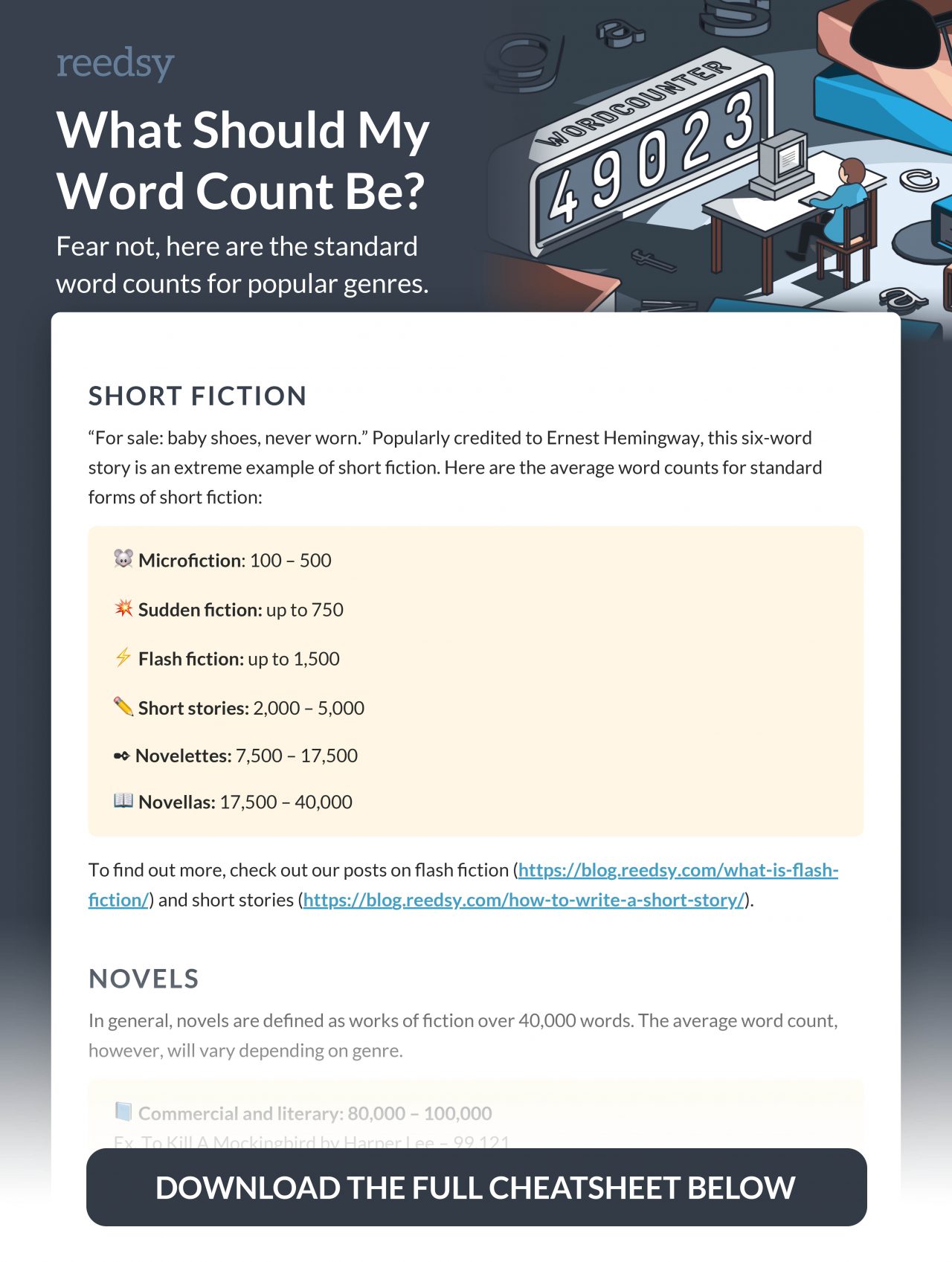
Enter your email address for Reedsy’s Word Count Cheatsheet!
We’ll send it to your inbox right away.
Every sentence works harder than the last
If we’re right to attribute it to him, “For sale: baby shoes, never worn” is far from Hemingway’s only foray into flash fiction. He was a prolific practitioner of the form — and a good one, too. So let’s look at an example of his work to see what makes short shorts so engaging.
«Chapter V», a vignette from Hemingway’s collection In Our Time, follows the typical arc of great flash fiction: starting with a straightforward but violent hook that summarizes the plot, it reveals more and more with each subsequent sentence.
“They shot the six cabinet ministers at half-past six in the morning against the wall of a hospital. There were pools of water in the courtyard. There were wet dead leaves on the paving of the courtyard. It rained hard. All the shutters of the hospital were nailed shut. One of the ministers was sick with typhoid. Two soldiers carried him downstairs and out into the rain. They tried to hold him up against the wall but he sat down in a puddle of water. The other five stood very quietly against the wall. Finally the officer told the soldiers it was no good trying to make him stand up. When they fired the first volley he was sitting down in the water with his head on his knees.”
After a matter-of-fact opening, Hemingway immerses the reader in the moment with evocative and sensory language. Then, at the midpoint, he adds a new detail that completely changes our understanding of the story: “One of the ministers was sick with typhoid.” The simple, straightforward sentences that follow don’t waste words or move in circles — each builds on the last and moves the story forward with momentum and intent.
The last line brings new meaning to the first: the execution of six bureaucrats becomes the execution of a sick, dying man. What began as an impersonal report, ends as a vivid portrait of human suffering — with us right in the room. Hemingway gives us just enough to empathize with the bureaucrat and even make us feel complicit for having so casually witnessed this.
Since no sentence can go to waste, good flash fiction pieces move forwards with tremendous momentum, and make hairpin turns at breakneck speed. Not every short will be as gut-wrenching as that piece from Hemingway — but since the form carries drama and unexpected twists so well, many of the best ones are!
As a creative exercise, they’re practically perfect
Micro-stories aren’t just great for readers who are short on time (or attention). They’re also a great way for writers to experiment in a low-stakes environment. Challenging you to spotlight a smaller story while hinting at a larger one, flash fiction teaches you to squeeze more out of every word.
What’s more, while writing flash fiction isn’t necessarily easy, it certainly isn’t as time-consuming as writing a novel. If you can write short shorts regularly — perhaps between bouts of writer’s block — you can share them quickly and build a fanbase that will yield dividends come publication time. But all of that isn’t to say that flash fiction is just a means to an end.
Free course: Build a solid writing routine
Don’t let your busy schedule stop you from becoming a writer. Learn how to build an unbreakable writing habit. Get started now.
Magazines and contests actively seek them out
Flash fiction is an art form with buckets of potential in and of itself. And if you decide that flash fiction is the form for you, there are plenty of publications looking to publish and celebrate small but mighty stories. (Some offer payments, too!) Here are six to get you started:
You can search for more opportunities using our directory of literary magazines, or by filtering for flash fiction in our writing contests directory. Searching for “litmag” on Twitter should also yield a bunch of results. But don’t forget that micro-stories are very easy to publish yourself! Because they’re so short, a prolific author can release them in a continuous stream through social media accounts or via a blog or email list.
When you’re ready, be sure to check out the next post in this guide to learn how to write a micro-masterpiece.
Flash Fiction Stories: 25 Examples of Lighting-Fast Stories

Flash fiction is one of the most fascinating creative mediums in this day and age: incredibly difficult, but also incredibly rewarding. After all, flash fiction requires writers to effectively cramming a whole narrative into 1,500 words or less.
But when writers rise to this challenge, the results can be exquisite. This post is dedicated to those dazzling flash fiction examples. We’ll cover works by the masters of the medium, from Franz Kafka to Joyce Carol Oates. Some stories are a few paragraphs long, some a few lines, and others only a few words — but all of them display storytelling ability that’s out of this world. Without further ado, here are 25 flash fiction examples worth a (very quick) read!
If you’re feeling overwhelmed by the number of great short stories out there, you can also take our 30-second quiz below to narrow it down quickly and get a personalized short story recommendation 😉
Which short story should you read next?
Discover the perfect short story for you. Takes 30 seconds!
1. “ Angels and Blueberries ” by Tara Campbell
Word count: 744 words
First lines: “Why is the sky blue?” you ask. Well, it all depends on who’s answering.
Campbell’s sweet, wholesome story posits various explanations for the color of the sky, one of which (naturally) involves angels and blueberries. Besides making you crave a fruit smoothie, it’ll open your eyes to the delightful possibilities of imagination when we disregard science for a few minutes.
2. “ As the North Wind Howled ” by Yu Hua
Word count: 1,371 words
First line: Sunlight had sneaked in through the window and was creeping toward the chair where my pants dangled. I was lying bare-chested in bed, rubbing some gunk from the corner of my eye. It must have collected while I was sleeping, and to just let it stay there seemed inappropriate.
Translated from the original Chinese, this brilliantly bizarre story follows a man who awakens one morning to find a stranger pounding down his door. The stranger insists that he’s come to visit his sick friend — the only trouble is, our narrator has no idea who he’s talking about. The uncanniness escalates from there, culminating in a dark yet comic ending that deftly comments on the oppressive nature of social obligations.
Looking for something new to read?
Trust real people, not robots, to give you book recommendations.
Or sign up with an email address
3. “ Baby Dolls ” by Becky Robison
Word count: 175 words
First line: My mother isn’t always Raggedy Ann, but she was when I was born.
This super-quick vignette from Becky Robison manages to be profoundly moving and disturbing at the same time. It details the circumstances of the narrator’s birth, during which her mother was dressed as Raggedy Ann… or had perhaps morphed into her, depending on how you interpret the poetic prose.
4. “ Curriculum ” by Sejal Shah
Word count: 490 words
First lines: The map was printed on a handkerchief. It is a map of a place that no longer exists.
One of the most praised pieces of flash fiction examples in recent memory, “Curriculum” is divided into three parts: Area Studies, Women’s Studies, and Visual Studies. As you might expect, however, the details of each are not purely academic, but provide a rich context for the narrator’s life — particularly her relationships to cultural identity, womanhood, and her mother.
5. “ Give It Up! ” by Franz Kafka
Word count: 128 words
First line: It was very early in the morning, the streets clean and deserted, I was walking to the station.
“The Metamorphosis,” “The Trial,” and “The Castle” are all very good stories, but “Give It Up!” is a perfect summation of the Kafkaesque: disconcerting and ultimately hopeless. Clocking in at just over 100 words, it’s also one of the most impressive feats of flash fiction by an author largely known for his full-length works.
6. “ Girl ” by Jamaica Kincaid
Word count: 681 words
First lines: Wash the white clothes on Monday and put them on the stone heap; wash the color clothes on Tuesday and put them on the clothesline.
From the author of A Small Place comes this insightful passage on what it means to be a girl, presented in an almost stream-of-consciousness series of instructions. From how to cook and clean to the most appropriate ways to present oneself to men, “Girl” potently demonstrates the many near-impossible standards that women are expected to fulfill without faltering. Don’t worry, though — there are a few surprisingly optimistic moments in the piece as well.
7. “ John Redding Goes to Sea ” by Zora Neale Hurston
Word count: 750 words
First lines: The villagers said that John Redding was a queer child. His mother thought he was too. She would shake her head sadly, and observe to John’s father: “Alf, it’s too bad our boy’s got a spell on ’im.”
8. “ Housewife ” by Amy Hempel
Word count: 43 words
First lines: She would always sleep with her husband and with another man in the course of the same day, and then the rest of the day, for whatever was left to her of that day, she would exploit by incanting, “French film, French film.”
A quintessential work of microfiction, this single sentence encapsulates the experience of a bored but clearly aspirational housewife. We’ve copied it here in its entirety for you to enjoy:
9. “ Likable ” by Deb Olin Unferth
Word count: 335 words
First lines: She could see she was becoming a thoroughly unlikable person. Each time she opened her mouth she said something ugly, and whoever was nearby liked her a little less.
Another superb meditation on womanhood, Unferth’s story dissects what comes after the stage of Kincaid’s “Girl”: that is, the process of growing older and becoming less “valuable” in the eyes of society. This heart-wrenching piece will resonate with any woman over the age of 40, and force the rest of us to confront what exactly makes the narrator feel so unlikable.
10. “ My Dead ” by Peter Orner
Word count: 1,283 words
First lines: Her name was Beth. We didn’t know each other. We took her car and headed to Missouri from Chicago. I remember that by the time we’d gone a few miles south on the Stevenson we’d already run out of things to say.
This piece tells the tale of two relative strangers attending a séance. But rather than using horror to compel readers, Orner turns instead to good old-fashioned wit: “What’s the hurry?” one of the characters says at one point. “Everybody’s already dead.” However, the ending will get your heart racing with its sudden hairpin turn into drama… and not in the spooky manner you might think.
11. “ Possession(s) ” by John Smolens
Word count: 875 words
First lines: When your wife dies, you find music tastes different and food sounds the same.
Though we’d normally steer clear of anything to do with a writer and his dead wife, “Possession(s)” proves that it can be done without a hint of misogyny — and indeed, with remarkable nuance. The narrator of this story describes the excruciating process of adjusting to a new life when one’s spouse passes away — namely, figuring out what to do with her things. Infused with incredible emotion and rendered in beautiful prose, “Possession(s)” is an affecting account of mourning that you won’t soon forget.
12. “ Ramona ” by Sarah Gerkensmeyer
Word count: 1,132 words
First lines: Ramona used to say, “When it’s on the outside I feel self-conscious.”
“Ramona” is another great flash fiction example: a compelling combination of Miranda July-esque, intimately observational prose and unexpected elements of the surreal. The narrator is best friends with (and has romantic feelings for) the eponymous Ramona, who wears her heart outside her body… literally. Pain, love, and an incisive sense of nostalgia all intertwine in this roughly thousand-word short story.
13. “ Riddle ” by Ogbewe Amadin
Word count: 1,159 words
First lines: I think Aunty Adesuwa is a witch. Mama says so sometimes.
If you’ve ever pondered the true nature of good, evil, and the shades in between, you’ll likely sympathize with young Idara. Her mother claims that Idara’s aunt is an evil witch — but from what she knows of Aunt Adesuwa, this can’t possibly be true. Or can it? Contemplative and haunting, this story (and especially its resolution) has the staying power of a much longer piece.
14. “ Sorry Dan ” by Erik Cofer
Word count: 734 words
First lines: I like you, Dan, I really do. You’ve been the face of this company for many years, overseeing a period of unprecedented net growth. And on a more personal level, you’ve become a dear friend. Heck, our wives attend spin class together twice a week! But unfortunately, friendship only means so much in today’s cutthroat business environment.
The full title is this one is actually “Sorry Dan, But It’s No Longer Necessary For a Human to Serve As CEO Of This Company”. which pretty much sums it up. Published in McSweeney’s in 2014, Cofer’s satirical letter to a boss made obsolete by his robotic counterpart has only become more relevant over the past few years. Not to mention that its apologetic-but-firm tone flawlessly imitates actual downsizing notices.
15. “ Sticks ” by George Saunders
Word count: 392 words
First lines: Every year Thanksgiving night, we flocked out behind Dad as he dragged the Santa suit to the road and draped it over a kind of crucifix he’d built out of metal pole in the yard.
“Sticks” is one of the best-known pieces of flash fiction this side of Hemingway’s alleged baby shoes — perhaps because it puts a serious spin on the infamous Seinfeld Festivus pole. The narrator’s father keeps a metal pole in their yard and decorates it not just for the winter holidays, but for every significant occasion: Groundhog Day, Veteran’s Day, the Super Bowl, etc. Yet his affection for the pole doesn’t seem to extend to his own children. Fans of David Sedaris’ dysfunctional family anecdotes: this is the story for you.
16. “ Taylor Swift ” by Hugh Behm-Steinberg
Word count: 500 words
First lines: You’re in love; it’s great, you swipe on your phone and order: the next day a Taylor Swift clone shows up at your house.
The premise of this wonderfully weird story is that anyone can order a perfectly replicated clone of Taylor Swift straight to their front doorstep — or multiple clones, if you want to build yourself a herd. Another one of those much-praised bit of flash fiction examples from the past few years, “Taylor Swift” is like a Black Mirror episode meets celebrity fanfiction meets… well, you just have to see for yourself.
17. “ Three Is A Rational Number ” by Michele Finn Johnson
Word count: 1,055 words
First lines: Lola’s lost her rational numbers worksheet. She’s got the whole school bus looking for it — when Lola says to do something, it’s like she’s an orchestra conductor and we all just fall in line.
This is a funny, poignant glimpse into the minute melodrama of seventh grade: the narrator’s twin sister, Lola, starts dating the “goon” of Darby Junior High, Billy Maguire. Needless to say, her brother isn’t exactly thrilled, and even less so when Lola starts cheating off Billy’s algebra papers. Vivid details and an authentically juvenile voice will transport you right back to your own seventh-grade bus scandals — especially if they involved copying homework.
18. “ The Huntress ” by Sofia Samatar
Word count: 374 words
First line: For fear of the huntress, the city closed like an eye.
A gorgeous piece of almost folkloric flash fiction, “The Huntress” describes its titular predator in ambiguous terms (“a stench of fur,” “she left a streak”) that somehow makes its terror even more palpable. Though critics are divided on whether the Huntress is meant to be a metaphor, the evocative strength of Samatar’s writing leaves an incredible impression.
19. “ The Wife on Ambien ” by Ed Park
Word count: 1,039 words
First lines: The wife on Ambien knows the score. I mean this literally. Rangers, 4–3 in overtime. Devils fall to the Flames, 3–1. Knicks lose again at home. In the morning, I open the paper and none of this checks out.
What does the wife on Ambien do? Quite a lot, according to Ed Park — even if she doesn’t remember it. This hypnotizingly anaphoric account of her musings, activities, and general welfare is equal parts sad and hilarious, complete with an ending that will have you questioning the narrator’s stability as well.
20. “ The Visitor ” by Lydia Davis
Word count: 342 words
First lines: Sometime in the early summer, a stranger will come and take up residence in our house.
Widely renowned as the queen of flash fiction, Lydia Davis has produced countless micro-stories over multiple anthologies, but perhaps none as excellent as “The Visitor.” Beginning with an anecdote about the narrator’s sister and a strange houseguest she once entertained, this barely 300-word story soon moves into unexpectedly sweet territory, and its usage of the past to anticipate the future is nothing short of subtle genius.
21. “ This Is How You Fail to Ghost Him ” by Victoria McCurdy
Word count: 959 words
First lines: Swipe right. Swipe right. Tinder. Bumble. Be unable to remember which, but this younger, generically handsome boy whose face reminds you of a Playmobil figure has driven from the suburbs tonight to meet you.
More of a thinkpiece than flash fiction per se, “This Is How You Fail to Ghost Him” nonetheless deserves a place on this list for its acerbic wit and all-too-cutting observations of modern dating life. If you read “Cat Person” and loved it, you’re sure to enjoy McCurdy’s writing here too.
22. “ Unnecessary Things ” by Tatyana Tolstaya
Word count: 677 words
First lines: This Teddy bear once had amber eyes made from special glass — each one had a pupil and an iris. The bear itself was gray and stiff, with wiry fur. I adored him.
Though translated from the original Russian, this piece retains a stunning sense of clarity in its rumination on “unnecessary things”: items that do not, or no longer, serve a commercial or useful purpose. Our narrator happens upon a teddy bear that fits this description, but her feelings for it still overwhelm her — and might just cause the reader to shed a tear, too.
23. “ War of the Clowns ” by Mia Couto
Word count: 571 words
First lines: One time two clowns set themselves to arguing. The people would stop, amused, to watch them.
This 571-word story gives new meaning to the phrase “clowning around,” as two battling jesters resort to more and more aggressive tactics. And while they entertain their spectators at first, their violent delights most definitely have violent ends.
24. “ Where Are You? ” by Joyce Carol Oates
Word count: 523 words
First lines: The husband had got into the habit of calling the wife from somewhere in the house — if she was upstairs, he was downstairs; if she was downstairs, he was upstairs — and when she answered, “Yes? What?,” he would continue to call her, as if he hadn’t heard and with an air of strained patience: “Hello? Hello? Where are you?”
Joyce Carol Oates’ simple yet elegant style lends itself extremely well to flash fiction examples, as this piece demonstrates. In just over 500 words, she paints a striking portrait of an elderly married couple and the discord between them, which stems from their inability to communicate.
25. “Widow’s First Year” by Joyce Carol Oates
Word count: 4 words
First lines: I kept myself alive.
Our final entry also comes from Oates, and probably holds the record for most succinct display of emotion in flash fiction history. Here it is, all four words of it — though of course, you also need the title to understand the full impact: I kept myself alive.
Want more quick reads? Check out these 11 interesting short stories that may change the way you think. Or try something a little different (but just as fast) by picking up some of the best graphic novels!
Trust book recommendations from real people, not robots.
Access Reedsy Discovery for free!
Or sign up with an
Recently discovered fiction books
New books are added every day. Read and vote for your favorites on the discover feed.